How Much Does Salesforce Cost for UAE & Saudi Arabia businesses in 2026?

Salesforce implementation costs (GCC SMBs) is the total investment for a 20-user team in the UAE and KSA typically ranges from $39,000 to $122,000 in the first year, covering licenses ($25–$175/user/mo) and professional setup fees.
If you’re running an SMB in the Gulf, you know that time is money. So guessing CRM costs is a luxury you don’t have. Licenses, implementation, add-ons, VAT, partner fees – all of it drains your budget, whether you like it or not.
The truth is: the platform you choose is powerful, but every feature comes with a price. In this article, we’ll break down how much does Salesforce cost for UAE & KSA businesses in 2026, covering:
- Mandatory and optional payments
- Hidden fees that sneak up on you
- Real-world examples for a typical team
By the end, you’ll have a clear picture of total investment and know exactly how to plan your fiscal year. But first things first.
Factors that affect Salesforce costs in 2026
You can’t just enter your company details, hit subscribe, and wait for magic. Not exactly rocket science, right? But it’s our mission to inform you that every made decision impacts the bottom line.
Get it wrong, and you’re overspending on features you don’t need, missing buried charges, or stuck with a system nobody uses. Understanding these factors separates smart budgeting from expensive mistakes:
- License type: Many expect Starter or Professional to cover everything. Surprise – automation limits, reporting caps, and missing integrations hit them fast. Teams either overpay for Enterprise features they don’t need, or underinvest and struggle with manual workarounds.
- Number of users: Companies often underestimate active users. Temporary staff, interns, or part-time sales agents get added later, and suddenly the monthly bill doubles.
- Additional products: Marketing Cloud, Service Cloud, AI tools – easy to get excited in the world full of trends and add them all. Most teams never use half the functionality.
- Implementation and consulting: Professional services cost money, but skipping them turns your CRM into just another software box gathering dust. Proper setup ensures your system delivers ROI.
- Regional factors: taxes, partner fees, and contract quirks catch companies off guard. Two SMBs with identical licenses can end up paying wildly different amounts simply because they didn’t account for local regulations or partner markups.
Salesforce pricing breakdown: UAE & Saudi Arabia
So now that we know where companies stumble and what really drives costs, let’s get to the math. Here’s the actual figures that are relevant exactly for the Gulf market.
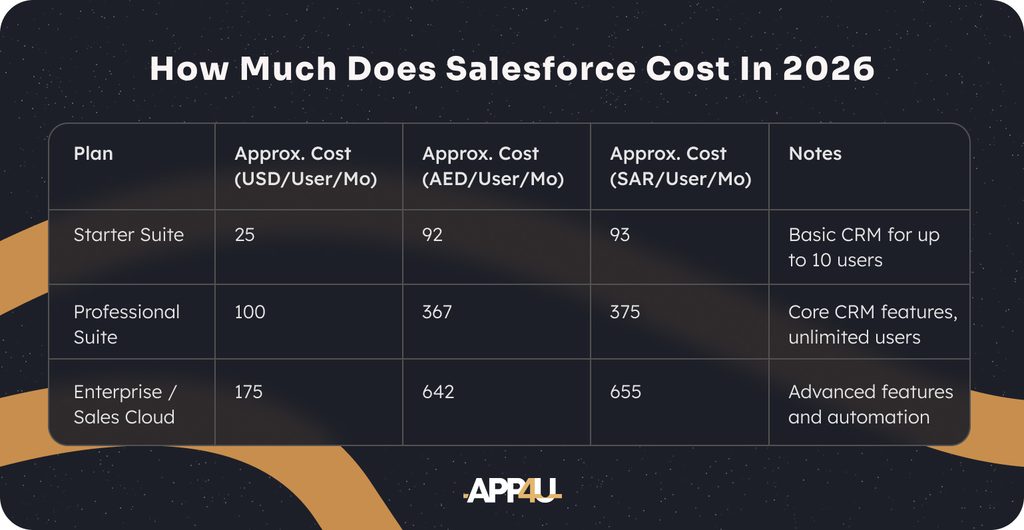
Prices shift slightly with VAT, currency fluctuations, and local partner fees, but these are the ballpark numbers you can rely on.
CRM implementation and consulting costs
Licenses are just the entry ticket. The real spend shows up the moment you move from “subscription” to actual implementation. Here’s what SMBs in the UAE and Saudi Arabia typically see in 2026:
- Basic setup: $8,000-$20,000
Suitable for small teams with straightforward sales processes and minimal integrations. Think core CRM configuration, standard objects, basic reports, and user onboarding.
- Mid-level complexity: $20,000-$60,000
This is where most growing SMBs land. Custom workflows, automation, tailored reporting, integrations with accounting or ERP systems, structured deal management. This is the system that supports scale, when your pipeline doubles.
- Advanced multi-cloud setup: $60,000+
Multiple departments, advanced automation, marketing tools, service workflows, data migration from legacy systems, custom development. At this level, you’re building infrastructure, each part of which requires financial commitment.
These numbers typically cover configuration, data migration, user training, workflow design, and integration with your existing systems.
What they don’t cover is indecision, scope creep, or endless internal changes – and that’s another place where budgets quietly expand.
Real examples: 3 scenarios of SMB сosts in 2026
Abstract pricing is one thing. Seeing what a real 20-user SMB in the UAE or Saudi Arabia actually spends in year one is what you can expect in practice.
Scenario 1. Lean sales setup
Who this fits: Early-growth SMB with a focused sales team and minimal integrations.
| Item | Cost |
| 3 users × Professional Suite ($100/user/mo) | $300 / month |
| Annual license cost | $3,600 |
| Basic implementation (core CRM, reports, training) | $5,000 |
| Estimated Year 1 Total | ~$8,600 |
What you get: Clean lead & opportunity management, basic dashboards, structured sales process, light automation.
Where companies struggle: Overlooking future needs, f.i, marketing automation or ERP integration.
Scenario 2. Growth-focused SMB
Who this fits: Scaling company with structured sales, reporting requirements, and at least one integration (ERP, accounting, or marketing tool).
| Item | Cost |
| 10 users × Professional Suite ($100/user/mo) | $1,000 / month |
| Annual license cost | $12,000 |
| Mid-level implementation (automation, custom workflows, ERP integration, advanced reporting) | $25,000-$35,000 |
| Estimated Year 1 Total | ~$37,000-$47,000 |
What you get: Automated workflows, structured deal stages, management dashboards, integration with finance or operations systems.
Where companies struggle: Scope creep. Once automation starts, departments may ask for “just one more feature,” and implementation hours expand.
Scenario 3. Advanced SMB
Who this fits: Mature SMB with multi-department Setup, including sales, service, and light marketing automation under one ecosystem.
| Item | Cost |
| 20 users × Enterprise / Sales Cloud ($175/user/mo) | $3,500 / month |
| Annual license cost | $42,000 |
| Advanced implementation (multi-department workflows, integrations, data migration, custom objects) | $60,000-$80,000 |
| Estimated Year 1 Total | ~$102,000-$122,000 |
What you get: Cross-department visibility, automation across teams, structured reporting for leadership, scalable architecture.
Where companies struggle: Adoption. Here, the real challenge is getting the team on board.
UAE vs Saudi Arabia – is there a difference?
For similar setups, Dubai and Riyadh budgets often land in the same range. Differences usually come from:
- VAT treatment
- Local partner pricing
- Contract structure
- Currency fluctuations
The platform costs are global. The implementation ecosystem is local.
Hidden costs and common challenges
Even after budgeting for licenses and implementation, SMBs often run into extra costs that aren’t obvious at first glance:
- Support plans: Premium support can tack on 20-30% to your license fees. Many teams skip it thinking “we’ll figure it out ourselves,” then spend twice as much fixing issues later.
- Add-ons: Analytics, AI tools, and AppExchange apps sound great – and they are – but every addition increases the grand total. Pick what brings value exactly for your workflows.
- Data migration: Moving existing records isn’t optional. Cleaning, importing, and mapping data consumes time, effort, and cash. Neglect it, and you end up with messy reports and frustrated teams.
- Contract renewals: Annual increases and extra fees often catch businesses by unplanned jump. What seemed affordable in year one can rise significantly if you don’t plan ahead.
In order for a Salesforce implementation to be successful, a number of factors need to be considered, including a client’s budget, needs, timeline, and expectations
Source: Salesforce Ben
Salesforce ROI for businesses in UAE & Saudi Arabia
Research shows that SMBs using CRM platforms like Salesforce see strong returns. On average, organizations report about 314% ROI over three years – meaning more than three dollars back for every dollar spent. In high‑adoption cases, ROI can climb to nearly 8x the initial investment.
The impact goes beyond money:
- ~30% faster communication and decisions
- ~30% productivity boost for users
- ~28% increase in sales results, with quicker deal closures in just 9 months.
These aren’t marketing claims – they’re measured outcomes from real SMB deployments. Industry benchmarks also confirm many see payback in under 12 months, with average sales productivity gains up to 27%.
A CRM isn’t a year-long experiment. Implemented thoughtfully, it delivers tangible results within fiscal cycles, improving revenue and efficiency across the business.
Comparison: Salesforce vs alternatives
The choice of CRM on price alone seems logical and simple. Harder to pick one that actually scales with your business.
| CRM | Starting Cost (USD/user/mo) | Notes |
| Salesforce Professional | 100 | Advanced CRM with regional partner support |
| HubSpot CRM | 45 | Free tier available, simpler features |
| Zoho CRM | 30 | Affordable, limited advanced features |
Cheap options may save money upfront but don’t scale, automate, or support you in the Gulf like Salesforce does.
! Note: Depending on your business needs and growth plans, a different CRM might suit you well. The key is choosing the tool that fits your team today and tomorrow.

Final thoughts
What can we say? You want Salesforce, you pay for Salesforce. Every line in a bill counts, and we get it – every dirham or riyal matters when you’re running a business.
Every feature adds up, so we lay it out straight for companies in the Gulf: what you pay, why it matters, and how to plan so your CRM actually drives results.
FAQ: Salesforce costs for the Gulf in 2026
1. How much does Salesforce cost per user in UAE & Saudi Arabia?
In 2026, Starter Suite $25/user/mo, Professional $100/user/mo, Enterprise/Sales Cloud $175/user/mo. Regional VAT, partner fees, and currency fluctuations may adjust the total.
2. What are the hidden costs SMBs should plan for?
Premium support (20–30% extra), add-ons like Marketing Cloud, AI, AppExchange apps, and data migration. Ignoring these leads to higher total spend.
3. How much does implementation cost for a 20-user team?
– Basic: $8,000–$20,000
– Mid-level (automation + ERP/accounting integration): $20,000–$60,000
– Advanced multi-cloud: $60,000+ (configuration, training, data migration, and workflow setup).
4. What ROI can companies expect?
Average 314% ROI over 3 years; high adoption can reach nearly 8x. Performance gains include ~30% faster decisions, ~30% productivity boost, ~28% increase in sales within 9 months.
5. Do UAE and Saudi Arabia budgets differ?
Base licenses are similar; differences come from VAT, local partner fees, and contract structures. Always factor in regional nuances for planning.