How SMBs in UAE and Saudi Arabia Buy CRM Software

The CRM decision journey in the GCC is a collaborative yet hierarchical evaluation process that typically spans 6 to 16 weeks. Unlike Western markets, CRM adoption in the UAE and Saudi Arabia is heavily driven by executive authority, local peer recommendations, and alignment with regional digital transformation goals like KSA Vision 2030.
In the UAE and Saudi Arabia, adopting a CRM system is not a simple tech purchase. For SMBs, it’s a strategic decision shaped by hierarchy, relationships, and practical influence networks.
This process – the CRM decision journey – reveals not just what gets chosen, but how and who drives the choice. And in this article, we discuss exactly that.
The state of local dynamics in UAE and KSA
Across both markets, CRM adoption is rising rapidly as part of digital transformation initiatives.
In the UAE, high CRM demand is driven by robust digital economies in cities like Dubai and Abu Dhabi and by the push toward cloud‑based, data‑driven customer engagement tools. About 94 % of the UAE business landscape consists of SMEs, placing CRM adoption at the heart of efforts to streamline operations and improve customer insights.
Saudi Arabia’s CRM software market is also growing due to Vision 2030 digital reforms, cloud and AI integration, and mobile solutions, particularly in Riyadh, Jeddah, and Dammam, as SMBs aim to improve customer management and analytics.
SMBs are experimenting with AI… driven by a strong desire to stay ahead of the curve and use the technology to improve the way their organisations work while boosting customer services.
Source: UAEnews247.com
Yet this growth doesn’t mean easy buying decisions. SMBs in both regions navigate complex approval layers and cultural expectations that influence CRM adoption differently from Western markets.
How to choose CRM: UAE and Saudi Arabia
When an SMB in the UAE or Saudi Arabia decides to invest in CRM, several distinct roles influence the outcome – each with their own focus and priorities:
- Owners / Managing Directors
In smaller SMBs, the owner or top executive holds the ultimate decision authority. Their concern is strategic: Will this CRM improve customer relationships and support growth? They often rely on outcomes from pilot trials and endorsements from other business owners before committing.
- General Managers and Heads of Departments
In mid‑sized SMBs, the GM or senior heads (e.g., Sales, Operations) lead the evaluation phase. They assess CRM capabilities against real operational needs – pipeline visibility, lead tracking, or customer service workflows – and then build structured recommendations for leadership.
- IT Advisors and Technology Leads
While not the final decision-makers, IT teams are critical in assessing integration, security, compliance, and scalability. They evaluate how CRM fits with existing systems and advise on technical risk, especially when data residency and compliance are key concerns in GCC markets.
This mix of voices explains why CRM decisions in the GCC are collaborative yet hierarchical. Leaders want technical assurance, operational fit, and strategic value. Successful CRM adoption requires aligning the perspectives of these influencers, not just selling features.

The decision journey: step-by-step process
Most SMB CRM choices follow a pattern, whether the company is in Dubai, Riyadh, Abu Dhabi, or Jeddah. The journey looks like this and serves not as isolated steps, but as a flow that your team may plan for:
Step 1. Problem recognition
At this stage, the company clearly defines what isn’t working and agrees that change is needed. It’s less about complaints and more about identifying measurable gaps – visibility, tracking, reporting, accountability.
The key outcome here is alignment: everyone agrees that a system is required, not just an adjustment. When owners are closely involved in operations (which is common in the region), this step tends to happen quickly.
👤 Who is involved: Sales or Operations Lead, often the Business Owner in smaller companies.
⚡ What affects it: Clarity of business goals and how directly revenue performance is impacted.
⏰ Typical duration: 1-2 weeks in small SMBs, longer if leadership is not directly engaged.
Step 2. Internal alignment
Now the discussion becomes practical. What exactly do we need the system to do? What processes must it support? What tools must it connect with?
This step defines scope. If skipped or rushed, the project slows down later.
👤 Who is involved: Business Owner / MD, Sales or Operations Lead, IT advisor (internal or external).
⏰ Typical duration: 1-3 weeks.
⚡ What affects it: Complexity of existing systems and how structured current sales processes are.
Step 3. External validation
The company looks for real-world confirmation. Peer experience, local partners, industry examples – something beyond the marketing claims. In UAE and KSA, recommendations and reputation often carry more weight than vendor branding or regalia.
👤 Who is involved: Business Owner, Sales Lead, sometimes Finance.
⏰ Typical duration: 1-4 weeks.
⚡ What affects it: Availability of trusted referrals and industry-specific requirements.
Step 4. Vendor evaluation & approval
Here the company compares options, reviews proposals, clarifies pricing, and evaluates implementation support. The decision is practical: choose the solution that fits operations and will actually be adopted.
👤 Who is involved: Business Owner (final sign-off), Sales/Operations Lead, IT advisor, Finance.
⏰ Typical duration: 2-6 weeks.
⚡ What affects it: Budget approval layers, contract terms, and integration requirements.
This journey typically spans 4-6 weeks in smaller SMBs and up to 12-16 weeks for mid‑sized ones due to multiple review and approval layers.
The power of recommendations and local CRM partners
One of the biggest blind spots for many businesses is underestimating the influence of trusted recommendations and local CRM partners.
Experience from peers in the same market – someone who has already implemented and is benefiting from CRM – often outweighs technical sales pitches. When a similar business in your city or sector assures you that a solution works, it immediately reduces hesitation.
Local partners, like App4U, are consultants who know the UAE or Saudi Arabia business norms, compliance needs, and language requirements – serve two roles:
- Translator. We help you translate vendor promises into real outcomes for your company.
- Support engine. We assist with configuration, training, and change management so that CRM adoption becomes sustainable, not abandoned after rollout.
What makes CRM projects succeed in UAE & Saudi Arabia
In many SMBs, the CRM system itself is not the main risk. The risk is misalignment between expectations and daily operations. Successful projects in the region usually have three things in common:
🔸 First, they tie CRM to revenue.
Not “better reporting,” but measurable outcomes – higher conversion, shorter sales cycles, stronger follow-up control. When CRM is linked to financial performance, adoption becomes a business priority.
🔸 Second, they define the sales process before implementation.
CRM does not create structure. It formalizes it. If pipeline stages and ownership rules are unclear, the system will only make confusion more visible.
🔸 Third, leadership stays involved after go-live.
In both markets, executive behavior drives discipline. When leadership actively reviews CRM data and uses it in decision-making, teams adapt faster and usage stabilizes.
The real cost of delaying CRM
Delaying CRM in the UAE and Saudi Arabia may feel safe – operations still run. But in Saudi Arabia, the CRM market is already around USD 2 billion, while in the UAE cloud-based systems are central to modern customer engagement.
Without CRM, data stays scattered, forecasts are reactive, and growth relies on individuals rather than structured processes. Problems may not be obvious day-to-day, but they limit predictable scaling and make revenue less reliable.
SMB owners confirm that adoption, not software, is the main challenge. Tools that match real workflows and deliver clear team benefits succeed; delays mean missed opportunities and leave competitors ahead.
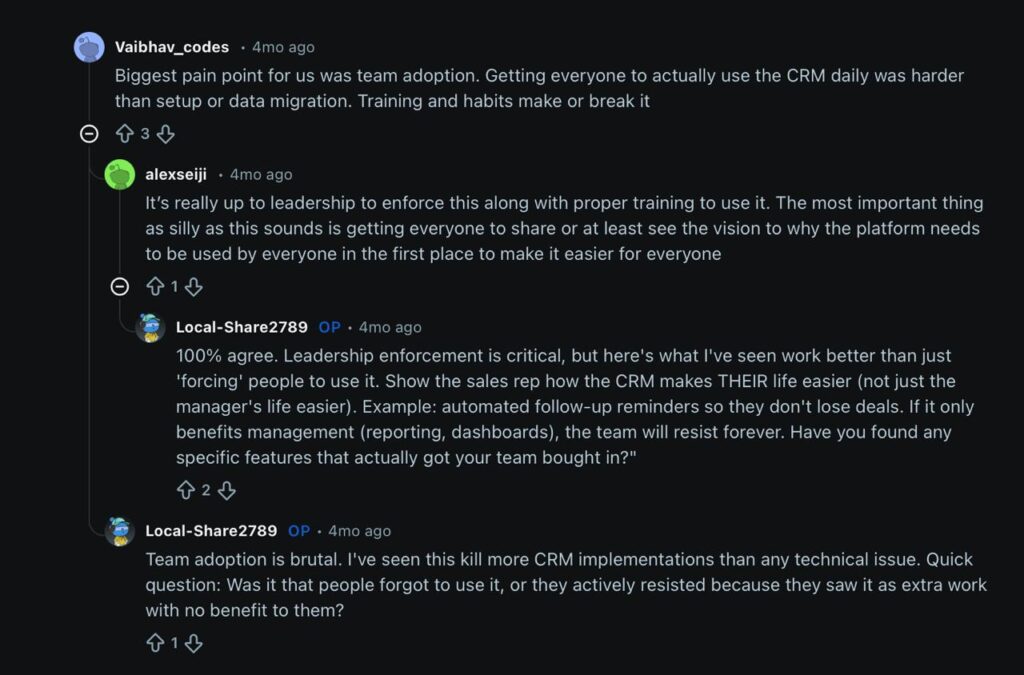
Source: Reddit.com
In fast-moving markets like Dubai, Abu Dhabi, Riyadh, and Jeddah, postponing CRM directly slows growth, weakens competitive position, and reduces operational predictability. CRM is not just software – it’s the backbone for structured, measurable business outcomes.
Final thoughts
CRM is often mistaken for a technical purchase, but the truth is deeper: it’s a business transformation investment. When evaluated through the lens of how decisions are actually made – with multiple influencers, real peer feedback, and local expertise – CRM adoption becomes less risky and more predictable.
For SMBs in UAE and Saudi Arabia, this understanding is what turns CRM into a tangible advantage instead of another software expense.
FAQ: How SMBs in the Gulf buy CRM software
1. Who decides on CRM adoption in UAE and KSA SMBs?
In smaller SMBs, Owners or Managing Directors hold final authority. Mid-sized companies rely on GMs, department heads, and IT advisors to assess operational fit and risks.
2. How long does the CRM decision journey take?
Small SMBs usually complete it in 4-6 weeks, while mid-sized ones may take 12-16 weeks due to multiple approval layers.
3. What role do recommendations and local partners play?
Trusted peer feedback and local partners reduce adoption risk, translate vendor promises into real outcomes, and provide support for configuration, training, and change management.
4. What drives CRM project success in UAE & KSA?
Link CRM to measurable revenue outcomes, define sales processes before implementation, and ensure leadership actively uses the system after go-live.
5. Why is delaying CRM adoption costly?
Delays fragment data, slow forecasting, and leave growth dependent on individuals rather than structured processes, reducing competitiveness and predictable revenue.

![What is CRM? Guide for Growing SMBs in the Gulf [+ Use Cases]](https://app4u.dev/wp-content/uploads/2026/03/representation-user-experience-interface-design-2-scaled.jpg)