What is CRM? Guide for Growing SMBs in the Gulf [+ Use Cases]
![What is CRM? Guide for Growing SMBs in the Gulf [+ Use Cases]](https://app4u.dev/wp-content/uploads/2026/03/representation-user-experience-interface-design-2-scaled.jpg)
CRM (Customer Relationship Management) is a strategic business system that centralizes customer data, lead tracking, and communication history into a single source of truth to drive growth and efficiency.
Single Source of Truth (SSOT) is an architectural concept where all business data is consolidated into one central repository (like Salesforce). In the UAE and Saudi markets, SSOT eliminates “manual reports” and data silos, ensuring that management and sales teams act on the same, verified information.
Many small and mid-sized businesses start with basic systems. Leads come through WhatsApp, LinkedIn messages, emails, and spreadsheets. They feel familiar and cheap.
At first, that worked.
Growth is usually what exposes the cracks. More leads, longer sales cycles, multiple team members touching the same deals – and, suddenly, what once felt simple becomes fragile. This is when CRM becomes essential.
First, what is CRM for small business in UAE & KSA?
CRM stands for Customer Relationship Management. But treating it as just a database or a contact list misses the point.
At its core, CRM is about how a business manages relationships at scale – with prospects, customers, and partners – without relying on individual memory or fragmented tools. A modern CRM system creates a shared, structured view of:
- Who your customers are
- How and when you interact with them
- What opportunities are open, won, or lost
- What actions need to happen next
- Which channels bring the most revenue
Instead of information living in inboxes, personal phones, or disconnected files, CRM centralises it into one system that the whole team can rely on. For growing SMBs, this shift is more about reducing dependency on people and increasing dependency on process – without killing agility.
Why CRM matters more in 2026 than it did five years ago
In the past, CRM was mainly used as a more trendy (and expensive) alternative to Excel. Today, it is central to growth, efficiency, and customer experience. Several factors make CRM indispensable:
Higher customer expectations
79% of customers expect consistent interactions across all channels. Without a central system, delivering this at scale is nearly impossible. CRM provides a single view of each customer, ensuring timely and coordinated interactions.
Complex sales journeys
Deals often involve multiple stakeholders and touchpoints. Companies using CRM shorten sales cycles by 8-14 days, preventing opportunities from slipping through the cracks. A unified system keeps all deal information in one place, so teams can act fast and reliably.
Faster team growth
91% of companies with 10+ employees now use CRM to automate routine tasks and maintain a single source of truth. This ensures growing teams stay aligned, avoid duplicated work, and scale efficiently.
Intense digital competition
Businesses are now competing not only at a local level – they should keep up globally. The global CRM market is projected at $112.9B in 2025, reflecting adoption across regions. CRM standardizes processes and centralizes data, keeping teams coordinated and competitive no matter the location.
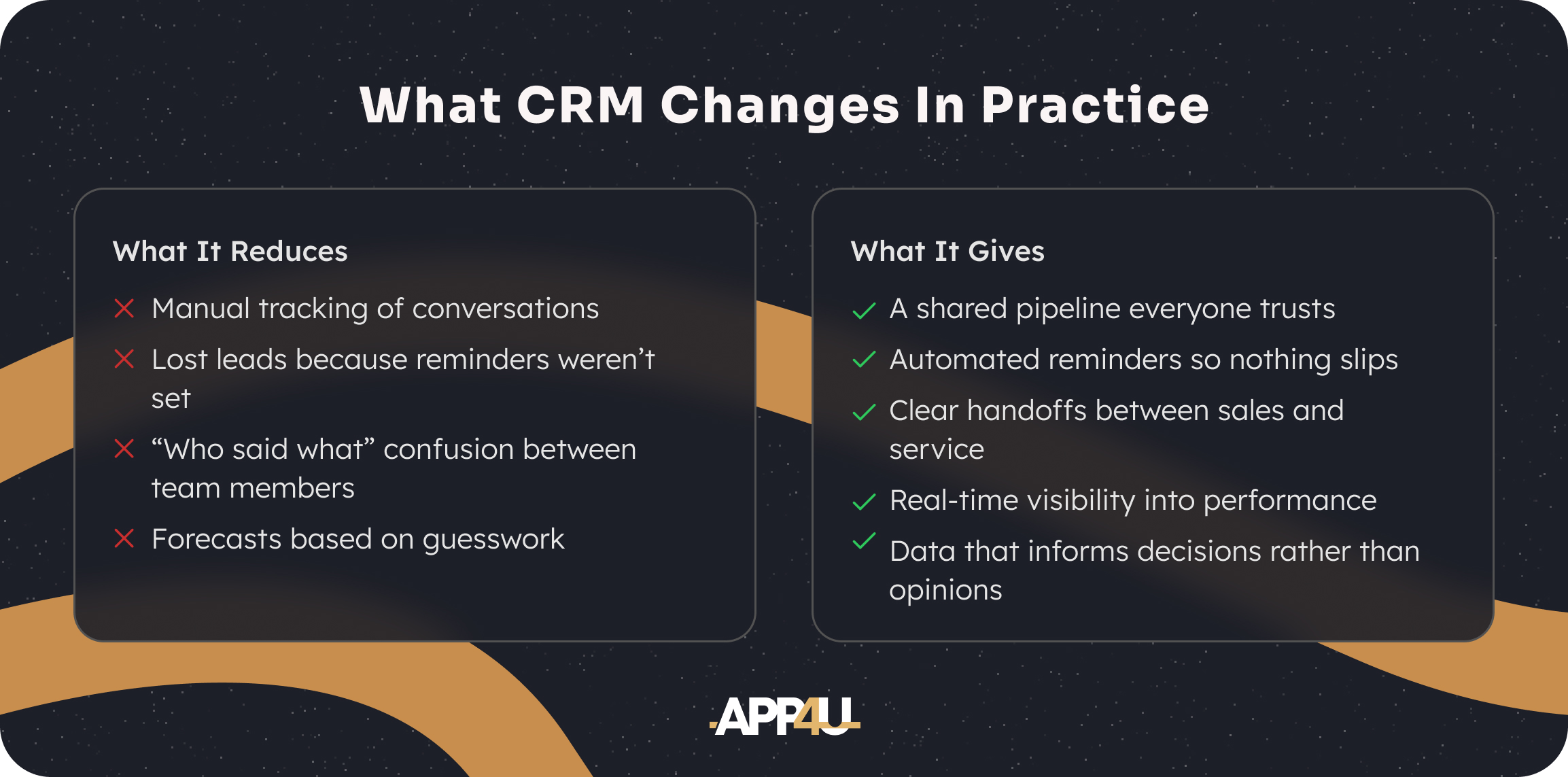
Ok, but how does this apply to the Gulf region?
Why SMBs in UAE & Saudi Arabia need CRM now
SMBs in the region operate in a fast-moving, relationship-driven market. Whether deals start through personal networks, referrals, or events, speed and clarity determine success. At the same time, many businesses are scaling faster than their internal processes can handle.
CRM addresses these challenges in three practical ways:
First, it brings structure without bureaucracy. Many founder-led or family-run businesses hesitate to implement formal systems. A well-configured CRM provides clarity and consistency without slowing down teams.
Second, it preserves relationships. In many Gulf SMBs, deals rely on personal connections. CRM ensures these referral conversations are tracked and nurtured even when team members change roles.
Third, CRM enables controlled growth across locations. As companies expand across emirates, cities, or even currencies, CRM maintains consistent processes, visibility, and reporting. Essentially, it makes growth manageable.
Our advantage is this all comes together on one platform, putting the customer at the center, deepening trust, elevating employees, building enduring customer relationships.
Source: Salesforce.com
Salesforce is synonymous with CRM – and for good reason
Salesforce is one of the most established CRM platforms globally. For SMBs in the UAE and Saudi Arabia, its relevance lies in flexibility rather than brand recognition. And that’s why:
- Local presence. Offices in Dubai and plans for Riyadh show a long-term commitment to the region.
- Scalability. Teams can start small with contact and deal tracking, then expand into automation, analytics, and integrations.
- Alignment with digital transformation. Salesforce supports Vision 2030 in Saudi Arabia and UAE initiatives by digitizing operations, centralizing data, and enabling smarter decision-making.
- Cloud-native & remote-ready: Teams can access real-time data from anywhere, supporting hybrid or distributed work models common in the region.
- Security & compliance: Enterprise-level protection ensures sensitive customer data is safe, while helping meet regional regulations and standards.
All of these features show why Salesforce is trusted by companies in the region. But the real impact becomes clear when you see how it works in practice.
CRM in action: use cases from Gulf SMBs
Sometimes, the value of CRM is best understood through simple, real-world scenarios. Here are three examples typical for UAE & Saudi businesses.
The Dubai event management company
The boutique event company that specializes in corporate events and private parties across Dubai. With only 15 staff, including sales, event coordinators, and operations, they struggled to track client requests, vendor contacts, and follow-ups across multiple channels.
❌ Before CRM: Client details were spread across messengers, emails, and spreadsheets. Follow-ups were inconsistent. Deals were missed when account managers left the company.
✅ After CRM: A centralized system allowed the team to track leads, manage event schedules, and maintain a clear pipeline. Within the Q1, they saw a noticeable improvement in follow-up discipline, which contributed to closing ~15-20% more deals compared to the previous period.
The Riyadh construction supplies distributor
A mid-sized distributor supplying contractors and retailers across Riyadh and neighboring cities. With around 75 employees across five branches, including sales, warehouse, and operations teams, they struggled to manage quotes, inventory, and customer requests consistently.
❌ Before CRM: Multiple sales reps covering different cities, inconsistent pricing updates, and delayed quotes.
✅ After CRM: Customer data and product pricing were centralized, and quote generation became more structured. Managers gained clearer visibility into pipeline health across branches. Over the six months, average lead response time decreased significantly, in some cases by up to 50% – particularly in branches that fully adopted the new workflow.
The Abu Dhabi marketing agency
A creative agency handling multiple marketing campaigns for local clients. With roughly 40 staff including account managers, designers, and marketers, they found it challenging to track client communications, project deadlines, and campaign performance across current setup.
❌ Before CRM:Tracking campaigns, client interactions, and deadlines was chaotic.
✅ After CRM: By integrating marketing automation, the team structured campaign tracking, monitored engagement more systematically, and aligned sales follow-ups with client interactions. Over the next four months, repeat business increased by around 10-15%, largely due to improved visibility and more consistent client communication.
In each case, the impact did not come from the CRM software alone. Results followed clearer processes, defined ownership, and consistent team adoption. The system provided structure and visibility, but the business decisions remained human.
How you can get started
Well, we can agree that the challenge isn’t choosing a CRM. The main question is how to implement it while business keeps running today, right now, without pausing or disrupting ongoing processes.
The Quick Start approach solves this by focusing on what matters most first, so the system delivers value immediately.
The process begins by setting up the essentials your team uses every day: contacts, deals, and basic reporting. This creates a shared view of current problems and opportunities for future digital transformation. At the same time, the team is trained on simple, practical workflows, so using the CRM becomes part of daily work rather than an extra task.
Once the basics are running smoothly, additional features – like automation, dashboards, integrations, and analytics – can be added gradually. This allows the system to grow alongside the business, supporting expansion.

Some wait for the perfect setup.
We offer a Quick Start implementation to deliver first results in weeks.
Let's talkFinal thoughts
In 2026, Gulf SMBs can no longer rely on scattered tools. The real value of CRM is in creating a single source of truth for leads, deals, and customer interactions – reducing manual operations and freeing your team to focus on growth.
Start small, track what matters most, and expand as your business scales.
FAQ: CRM for Gulf SMBs in 2026
1. What exactly is CRM, and why does my SMB need it?
CRM (Customer Relationship Management) is a system that centralizes leads, deals, and customer interactions, helping teams manage relationships efficiently. For growing SMBs, it reduces errors, improves follow-ups, and ensures consistent processes as your business scales.
2. How does CRM help SMBs in the Gulf specifically?
Gulf SMBs operate in fast-paced, relationship-driven markets. CRM helps preserve personal connections, standardize workflows across multiple cities or Emirates, track opportunities in real time, and support growth without adding bureaucracy.
3. Why choose Salesforce over other CRM platforms?
Salesforce combines scalability, automation, integrations, and regional support. It works for small teams initially and grows with your business, helping you maintain control, comply with local regulations, and track customer interactions efficiently.
4. Can CRM be implemented without disrupting daily operations?
Yes. Approaches like Quick Start focus on essentials first – contacts, deals, and reporting – so your team sees immediate value while daily business continues smoothly. Additional features like automation, dashboards, and analytics can be added gradually.
5. How quickly can SMBs see results from CRM?
With a practical implementation plan, Gulf SMBs can start seeing improvements in lead tracking, follow-ups, and pipeline visibility within weeks. Early wins include faster response times, fewer lost opportunities, and clearer handoffs between team members.