CRM Adoption in UAE and KSA: Process, Culture, and Ownership Gaps

CRM adoption: The process of integrating a CRM system into a company’s daily operations and culture to ensure it becomes the primary source of truth for all sales and customer data.
CRM Adoption vs. Implementation is the distinction between the technical deployment of a CRM (implementation) and the long-term behavioral integration of the system into a company’s daily operations (adoption). In the GCC market, successful adoption requires closing processes, culture, and ownership gaps.
The UAE and Saudi Arabia are one of the most CRM-active markets in the Gulf. From fast-growing startups in Dubai to established distributors in Riyadh, many companies have already invested in systems such as Salesforce, HubSpot or Microsoft Dynamics.
Yet real CRM adoption for most businesses remains uneven.
The issue is rarely the platform itself. On paper, digital infrastructure looks solid. The devil is in the process design, company culture, and ownership gaps. This article explains:
- Why CRM adoption fails in UAE & KSA companies
- What makes CRM implementation different in the Gulf
- The three structural gaps blocking adoption
- Real example of CRM adoption failure in 2026 and how to fix it
CRM adoption vs CRM implementation
Many companies treat implementation as success, but real impact depends on adoption – and understanding of this difference is critical.
❗Implementation is a project milestone. It means the system is configured, data is migrated, users are trained, and go-live happens. It is finite and measurable.
‼️ Adoption, by contrast, is an organizational shift. It’s behavioral and ongoing. It reflects whether the organization has fully integrated CRM into its daily operating rhythm. It determines whether managers trust CRM data more than anecdotal updates. It shapes whether pipeline forecasts are defensible or speculative.
In both the UAE and Saudi Arabia, many SMBs achieve technical deployment within 3-6 months. But sustained CRM adoption requires something deeper: clarity of process, cultural alignment, and explicit ownership.
Without those foundations, even the most advanced CRM system becomes a parallel reporting tool rather than the backbone of revenue operations.
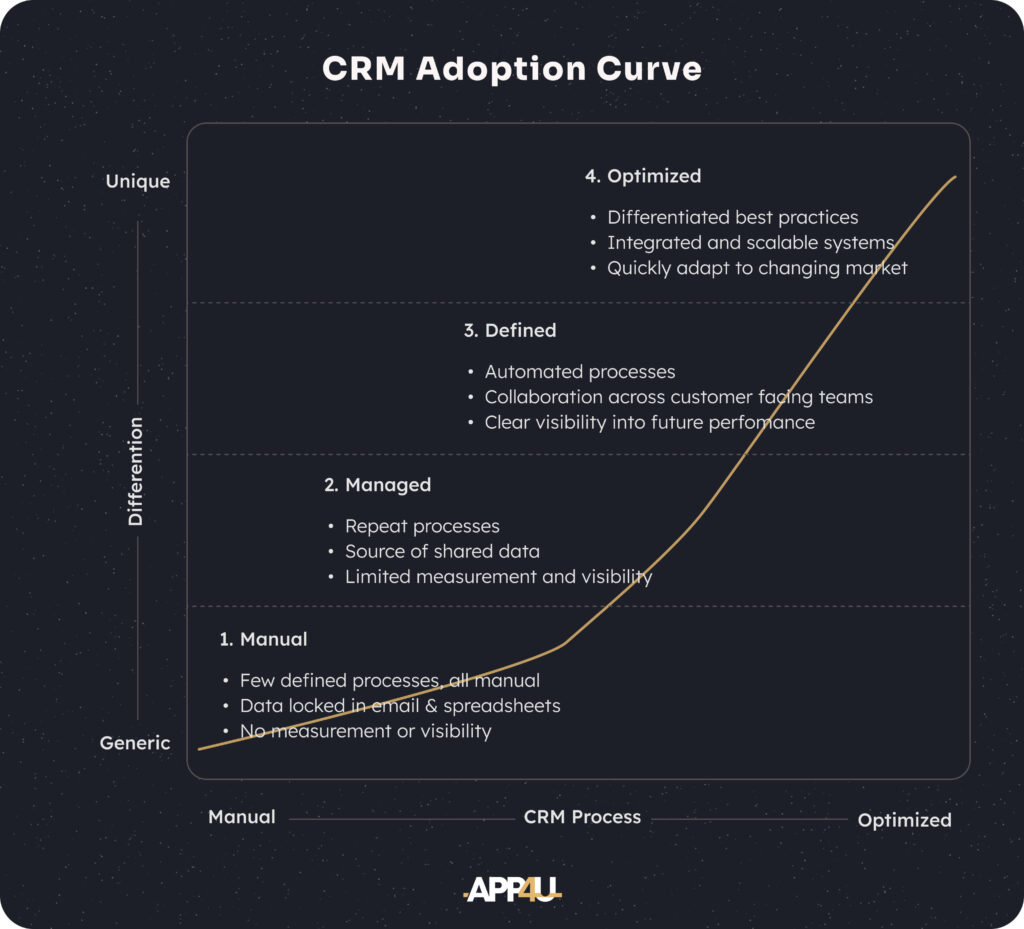
Why CRM adoption in UAE and KSA is structurally different
Business culture in the UAE and Saudi Arabia carries distinct characteristics that directly influence CRM outcomes. This is the current landscape:
- Highly international, with multicultural sales teams
- Fast-moving and opportunity-driven
- Often founder-led, especially in SMBs
- Strongly relationship-oriented
- Characterized by relatively high sales staff mobility
Commercial relationships are central, but trust often precedes formal documentation. Sales cycles may begin through personal networks, referrals, majlis discussions, exhibitions, or high-context negotiations. Particularly in sectors such as real estate, construction, distribution, and B2B services, relationship capital remains a primary growth driver.
At the same time, both markets are undergoing rapid formalization. Saudi Arabia’s regulatory environment is tightening. The UAE’s investor ecosystem is increasingly data-driven. Venture-backed startups, family conglomerates, and government-affiliated entities are all demanding clearer revenue visibility.
CRM systems sit precisely at the intersection of these two realities: relationship-based selling and data-driven governance. This tension explains much of the adoption friction seen across the region.
Process gap – no clear sales operating model
Many SMBs in the Emirates and Saudi Arabia grow opportunistically. Leads arrive through government tenders, WhatsApp, referrals, or Instagram. Deal stages are undefined, and forecasting often relies on intuition. When CRM is implemented on top of this chaos, it simply digitizes confusion.
Pipeline stages exist but rarely reflect reality. One rep may mark a deal as “Negotiation” after sending a proposal; another waits for verbal confirmation. Forecast accuracy plummets, duplicate leads appear, and managers ask for manual reports. Implementation is complete, but adoption is already weakening.
Symptoms of process gap
- Pipeline stages don’t reflect reality
- Forecast accuracy below 50%
- Duplicate leads
- Managers ask for “manual reports”
The fix is straightforward, though often overlooked: define the sales lifecycle first. Clarify lead qualification, opportunity stages, ownership rules, and SLAs between marketing and sales. Only then can the CRM system reflect actual workflows and drive consistent behavior.
Culture gap – relationship-driven sales or data discipline?
Adoption struggles even further in relationship-driven cultures, typical in both the UAE and Saudi Arabia. Sales professionals often see their contacts as personal assets. Data entry feels like surveillance, not support. Deals move through informal channels, and verbal commitments often precede documentation.
This is particularly common in real estate, distribution, construction, and B2B trading. High staff mobility and commission-based incentives reinforce the pattern.
Symptoms of cultural barriers
- High sales rep mobility between companies
- Commission-based mindset
- Informal deal progression
- Verbal commitments before documentation
The cultural shift required is subtle but critical: CRM is not control. It serves as a risk management and scalable growth infrastructure.
Adoption improves when management uses CRM in meetings, commissions are tied to CRM-recorded deals only, and all reports come exclusively from the system. Parallel Excel tracking must be eliminated. Behavior aligns when incentives and examples reinforce it.
Ownership gap – who actually governs CRM?
Even with clear processes and cultural alignment, adoption fails if ownership is unclear. In many Gulf companies, IT handles technical support, sales expects configuration, founders anticipate immediate ROI, and consultants exit post-implementation. The result: CRM becomes a tool nobody fully owns.
Symptoms of ownership issues
- No RevOps function
- No internal CRM admin
- No budget for optimization
- No quarterly CRM audits
Assigning a single business owner, separate from IT or external consultants, changes everything. This owner ensures stage accuracy, enforces process adherence, tracks adoption metrics like login rates and pipeline hygiene, and runs quarterly audits. Ownership transforms CRM from a static project into operational infrastructure.

Real example: Typical CRM adoption failure
A 50-person B2B distributor in Dubai invested ~$40,000 in implementing Salesforce Sales Cloud. The system was configured correctly, data was migrated, and the team completed training within the expected timeline.
However, six months later, operational results did not reflect the investment:
- 30% of deals tracked outside CRM
- Forecast deviation 35%
- Management distrusts reports
- Sales team complains about “too many fields”
The issue was not technical configuration but operational discipline. Qualification criteria were undefined, opportunity exit rules were absent, and no single owner was accountable for CRM governance. Leadership expected usage – but never formalized or enforced it.
After clarifying stages, assigning clear ownership, and making CRM the only source of pipeline data, results shifted quickly: forecast accuracy reached 85%, the sales cycle dropped by 18%, and reporting became reliable.
The platform remained the same, but the operating model changed.
Why CRM adoption matters in 2026
The Gulf business environment is entering a phase where structured revenue visibility is no longer optional.
Saudi Arabia’s market expansion under Vision 2030 is attracting global investors and international partnerships. The UAE continues to position itself as a regional headquarters hub for multinational firms. In both countries, competition is intensifying and funding environments are becoming more disciplined.
Investors, lenders, and boards increasingly expect predictable forecasting, auditable sales pipelines, and transparent customer data governance.
CRM adoption therefore becomes a strategic capability, not a back-office improvement.
Companies that solve process clarity, cultural alignment, and ownership governance build scalable revenue engines. Companies that ignore these dimensions risk accumulating software costs without achieving operational maturity.
Final thoughts
CRM adoption in the UAE and KSA is not constrained by technology sophistication. The region has access to world-class platforms and implementation partners.
The real challenge lies in translating ambitious growth into structured operating models.
When sales processes are clearly defined, when leadership models data-driven behavior, and when ownership is explicitly assigned, CRM becomes more than a reporting tool. It becomes the backbone of predictable revenue in one of the world’s fastest-transforming regions.
In the Gulf, if you can’t predict revenue, you’re already behind.
FAQ: CRM Adoption in UAE & Saudi Arabia (2026)
1. Why do most CRM projects fail in UAE & KSA SMBs?
Implementation alone isn’t enough. Without clear processes, culturally aligned behaviors, and explicit ownership, CRMs end up as parallel reporting tools rather than operational backbones.
2. What’s the difference between CRM implementation and adoption?
Implementation = system setup, data migration, training, go-live. Adoption = behavioral integration, daily use, trust in CRM data, and measurable impact on pipeline and revenue.
3. How does Gulf business culture affect CRM adoption?
Relationship-driven sales, high mobility, and verbal commitments make data entry feel like surveillance. Adoption improves only when incentives, leadership modeling, and processes reinforce CRM as a growth tool — not a policing system.
4. Who should own the CRM internally?
A single business owner, separate from IT or external consultants, ensures stage accuracy, enforces process compliance, tracks adoption metrics, and runs audits. Ownership transforms CRM from static software into operational infrastructure.
5. How quickly can adoption improvements impact results?
With clarified processes and assigned ownership, SMBs in Dubai and Riyadh have improved forecast accuracy from ~50% to 85% and shortened sales cycles by 15–20% — all without changing the platform.
![What is CRM? Guide for Growing SMBs in the Gulf [+ Use Cases]](https://app4u.dev/wp-content/uploads/2026/03/representation-user-experience-interface-design-2-scaled.jpg)